Hanukkah gives theatre a clear sequence and a strong visual language: night follows night, another light is added, and a small household act becomes visible from beyond the room. For family audiences, that pattern can hold history, suspense, comedy and conversation without asking one story to explain every way the festival is observed.
Rededication and light
Hanukkah commemorates the rededication of the Temple in Jerusalem after its defilement by the Syrian Greeks. My Jewish Learning's introduction to Hanukkah describes the eight-day festival as both the Festival of Rededication and the Festival of Lights. Later rabbinic tradition connects its length with a small amount of oil that burned for eight days.
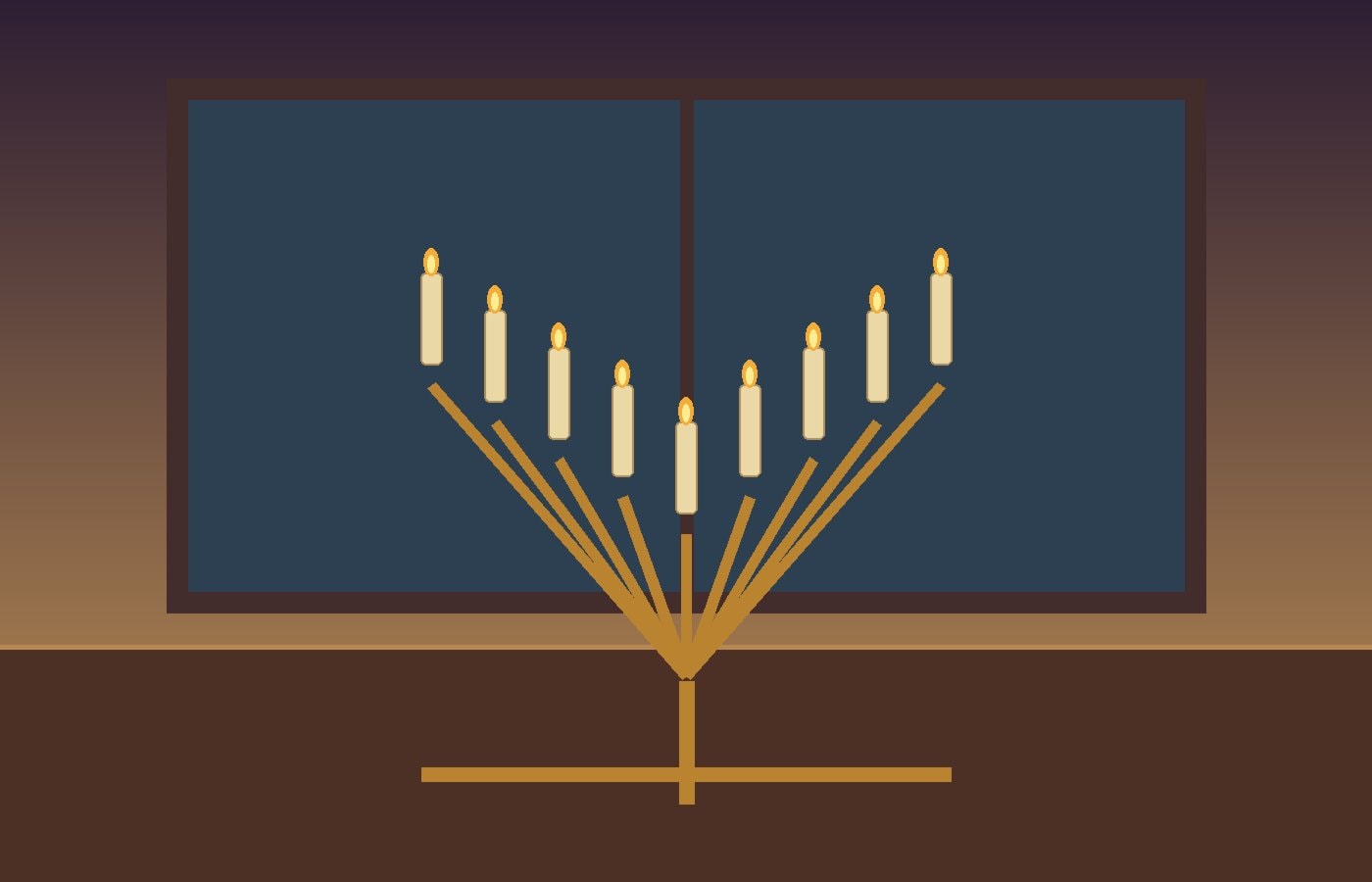
Candle lighting makes time visible. A light is added on each night until the hanukkiah, or Hanukkah menorah, holds the full sequence. Onstage, repetition with a change is one of the simplest ways to create expectation. An audience understands the pattern, notices each variation and feels the approach of the final night.
That visual progression also permits scale without clutter. A windowsill, a table and changing light can suggest a home, winter darkness and a public sign of practice. A family story can stay intimate while the candles quietly mark that the observance is meant to be seen.
A game already shaped for action
The dreidel is a four-sided spinning top associated with Hanukkah. Its motion contains a complete theatrical event in miniature: preparation, release, suspense and result. Different characters can approach the same spin with confidence, calculation, impatience or delight, so the object reveals temperament even before dialogue begins.
For younger viewers, a repeated game offers orientation. The rules create a structure that can be learned through watching, while chance keeps the next moment open. A playwright can use that rhythm for comedy or as a pause between more reflective scenes. The game belongs to the holiday setting, but it also performs useful dramatic work.
Holiday tales and hospitable storytelling
Stories for family audiences often benefit from a recognizable pattern, a problem that can be faced in stages and room for the youngest spectators to anticipate what comes next. Hanukkah's eight nights offer that architecture naturally. Candlelight can become a measure of time, while food, games and gathering supply sensory details that make the world immediate.
The Chanukkah Guest is among the holiday books written by Eric Kimmel. The reference entry on the author (Wikipedia) identifies it as a Sydney Taylor Book Award winner. On a theatre reader's shelf, that fact matters less as a label than as a prompt to notice how a warmly comic guest story can use mistaken identity, hospitality and holiday expectation.
The nearby page on Hershel and the Hanukkah Goblins offers a different family-story engine: the folk trickster. Its eight-night sequence turns repeated encounters into escalation, while wit rather than force drives the action. Together, the stories show how a festival can support both domestic comedy and folk-tale adventure.
Light in public life
Hanukkah stories may also help adults frame difficult history for children without making fear the center of the experience. In Billings, Montana, a brick was thrown through the window of a Jewish family's home amid a series of hate crimes. The account behind Not In Our Town (Wikipedia) describes how residents joined together in response and how the story became the beginning of a wider project.
The theatrical lesson is not that every painful event should become a holiday fable. It is that public symbols can invite public responsibility. A light in a window is at once domestic and visible; a neighbor's decision to answer intimidation changes the meaning of the street around it. Family theatre can present that civic idea plainly, with the emphasis on solidarity rather than on the person who committed harm.
Questions to carry into a family performance
Adults can listen for what the story assumes and what it explains. Does the play distinguish the historical rededication from the later oil tradition? Does it show one family's customs without presenting them as universal? Are children active thinkers inside the story, or only recipients of a lesson?
The strongest holiday theatre leaves room for delight. A spinning top can be funny, a repeated entrance can grow more surprising, and a row of candles can change the emotional temperature of the stage. Serious context and pleasure do not cancel each other. Each can make the other more legible.
From here, the guide to Jewish humour gives more background on comic tradition, while the history page places festive folk performance near the beginning of a much larger theatrical story.